
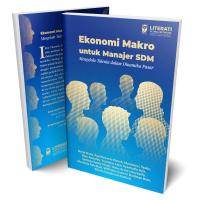
Ekonomi Makro untuk Manajer SDM: Mengelola Talenta dalam Dinamika Pasar
Kata Kunci:
Ekonomi Makro, Manajemen Sumber Daya Manusia, Siklus Bisnis, Kompensasi, Talent WarSinopsis
Ilmu Ekonomi Makro bukan sekadar urusan bankir atau pembuat kebijakan negara. Bagi praktisi SDM, fluktuasi ekonomi adalah “lingkungan ekologis” yang mendikte strategi pengelolaan talenta. Buku Ekonomi Makro untuk Manajer SDM hadir mendobrak sekat tersebut dengan memadukan teori ekonomi peraih Nobel dan realitas praktik HR modern. Temukan cara jitu menavigasi rekrutmen dan downsizing di berbagai siklus bisnis, menyelaraskan PDB dengan KPI karyawan, merancang kompensasi tahan inflasi, hingga memenangkan talent war di era AI dan gig economy. Jadikan buku ini sebagai senjata utama Anda untuk bertransformasi dari sekadar “administrator personalia” menjadi Strategic Business Partner yang mampu menakhodai perusahaan melintasi berbagai situasi ekonomi.
Bab
-
Ekonomi Makro sebagai Lingkungan Strategis SDM
-
Produk Domestik Bruto dan Perencanaan Angkatan Kerja
-
Produktivitas Nasional dan Manajemen Kinerja
-
Anatomi Pengangguran dan Strategi Rekrutmen
-
Pasar Tenaga Kerja dan Kekakuan Upah
-
Inflasi dan Daya Beli Karyawan
-
Kurva PhillipsInflasi dan Pengangguran
-
Nilai Tukar dan Manajemen SDM Lintas Negara
-
Kebijakan Fiskal dan MoneterDampaknya pada Anggaran SDM
-
Masa Depan Pekerjaan dalam Lanskap Makroekonomi
##plugins.themes.default.displayStats.downloads##
Referensi
Abel, A. B., Bernanke, B. S., & Croushore, D. (2020). Macroeconomics (10th ed.). Pearson.
Acemoglu, D., & Autor, D. (2011). Skills, tasks and technologies: Implications for employment and earnings. In O. Ashenfelter & D. Card (Eds.), Handbook of labor economics (Vol. 4, pp. 1043–1171). Elsevier.
Acemoglu, D., & Restrepo, P. (2018). The race between man and machine: Implications of technology for growth, factor shares, and employment. American Economic Review, 108(6), 1488–1542. https://doi.org/10.1257/aer.20160696
Acemoglu, D., & Restrepo, P. (2020). Robots and jobs: Evidence from US labor markets. Journal of Political Economy, 128(6), 2188–2244.
Agrawal, A., Gans, J., & Goldfarb, A. (2018). Prediction machines: The simple economics of artificial intelligence. Harvard Business Review Press.
Agusmidah. (2020). Hukum ketenagakerjaan Indonesia: Dinamika dan kajian teori. Ghalia Indonesia.
Akerlof, G. A. (1982). Labor contracts as partial gift exchange. The Quarterly Journal of Economics, 97(4), 543–569. https://doi.org/10.2307/1885099
Akerlof, G. A., Dickens, W. T., & Perry, G. L. (1996). The macroeconomics of low inflation. Brookings Papers on Economic Activity, 1996(1), 1–76. https://doi.org/10.2307/2534646
Akerlof, G. A., & Shiller, R. J. (2009). Animal spirits: How human psychology drives the economy, and why it matters for global capitalism. Princeton University Press.
Argente, D., & Lee, M. (2021). Cost of living inequality during the Great Recession. Journal of the European Economic Association, 19(2), 913–952. https://doi.org/10.1093/jeea/jvaa018
Arntz, M., Gregory, T., & Zierahn, U. (2016). The risk of automation for jobs in OECD countries: A comparative analysis (OECD Social, Employment and Migration Working Papers No. 189). OECD Publishing.
Arrow, K. J. (1973). The theory of discrimination. In O. Ashenfelter & A. Rees (Eds.), Discrimination in labor markets (pp. 3–33). Princeton University Press.
Arrow, K. J. (1998). What has economics to say about racial discrimination? Journal of Economic Perspectives, 12(2), 91–100. https://doi.org/10.1257/jep.12.2.91
Autor, D. H. (2015). Why are there still so many jobs? The history and future of workplace automation. Journal of Economic Perspectives, 29(3), 3–30.
Autor, D. H., Dorn, D., & Hanson, G. H. (2013). The China syndrome: Local labor market effects of import competition in the United States. American Economic Review, 103(6), 2121–2168. https://doi.org/10.1257/aer.103.6.2121
Autor, D. H., Katz, L. F., & Kearney, M. S. (2008). Trends in U.S. wage inequality: Revising the revisionists. Review of Economics and Statistics, 90(2), 300–323.
Autor, D. H., Levy, F., & Murnane, R. J. (2003). The skill content of recent technological change: An empirical exploration. Quarterly Journal of Economics, 118(4), 1279–1333.
Azar, J., Huet-Vaughn, E., Marinescu, I., Taska, B., & Von Wachter, T. (2023). Minimum wage employment effects and labor market concentration. The Review of Economic Studies. https://doi.org/10.1093/restud/rdad075
Badan Pusat Statistik. (2018). Pedoman praktis pencacahan Survei Harga Konsumen. BPS Indonesia.
Badan Pusat Statistik. (2020). Konsep dan definisi Indeks Harga Konsumen (IHK). https://www.bps.go.id/id/publication/2020/04/09/91a62fdd238c2b440752e161/indeks-harga-konsumen-di-82-kota-di-indonesia--2012-100--2019.html
Badan Pusat Statistik. (2023). Keadaan angkatan kerja di Indonesia Agustus 2023. BPS-Statistics Indonesia. https://www.bps.go.id/id/publication/2023/12/08/f8c567805aa8a6977bd4594a/keadaan-angkatan-kerja-di-indonesia-agustus-2023.html
Badan Pusat Statistik. (2024). Keadaan angkatan kerja di Indonesia Agustus 2024. BPS-Statistics Indonesia. https://www.bps.go.id/id/publication/2024/12/09/6f1fd1036968c8a28e4cfe26/keadaan-angkatan-kerja-di-indonesia-agustus-2024.html
Badan Pusat Statistik. (2024, August 5). Ekonomi Indonesia triwulan II-2024 tumbuh 5,05 persen (y-on-y). https://www.bps.go.id/id/pressrelease/2024/08/05/2381/ekonomi-indonesia-triwulan-ii-2024-tumbuh-3-79-persen--q-to-q---ekonomi-indonesia-triwulan-ii-2024-tumbuh-5-05-persen--y-on-y-.html
Badan Pusat Statistik. (2025). Labor force participation rate by sex, 2024. https://www.bps.go.id/en/statistics-table/2/MjIwMCMy/labor-force-participation-rate-by-sex.html
Badan Pusat Statistik. (2025, February 5). Indonesia’s economic growth in 2024 was 5.03 percent [Press release]. https://www.bps.go.id/en/pressrelease/2025/02/05/2408/
Badan Pusat Statistik. (2025, May 5). Unemployment rate was 4.76 percent, the average wage of employees was 3.09 million rupiahs [Press release]. https://www.bps.go.id/en/pressrelease/2025/05/05/2432/
Badan Pusat Statistik. (2025a). Keadaan angkatan kerja di Indonesia Februari 2025. BPS-Statistics Indonesia. https://www.bps.go.id/id/publication/2025/06/20/fec826c9a88adaa045a6ac9f/keadaan-angkatan-kerja-di-indonesia-februari-2025.html
Badan Pusat Statistik. (2025b). Keadaan angkatan kerja di Indonesia Agustus 2025. BPS-Statistics Indonesia. https://www.bps.go.id/id/publication/2025/12/19/42a75ee61332755586fdfcdd/keadaan-angkatan-kerja-di-indonesia-agustus-2025.html
Badan Pusat Statistik. (2025c). Unemployment rate by age group [Data set]. https://www.bps.go.id/en/statistics-table/2/MTE4MCMy/unemployment-rate-by-age-group.html
Badan Pusat Statistik Indonesia. (2023). Proyeksi penduduk Indonesia 2020-2050. BPS.
Balassa, B. (1964). The purchasing power parity doctrine: A reappraisal. Journal of Political Economy, 72(6), 584–596. https://www.journals.uchicago.edu/doi/10.1086/258962
Ball, L., Leigh, D., & Loungani, P. (2013). Okun’s law: Fit at fifty? (NBER Working Paper No. 18668). National Bureau of Economic Research. https://doi.org/10.3386/w18668
Ball, L., & Mankiw, N. G. (2002). The NAIRU in theory and practice. Journal of Economic Perspectives, 16(4), 115–136. https://doi.org/10.1257/089533002320951000
Bank Indonesia. (2020). Laporan inflasi (Indeks Harga Konsumen). Departemen Komunikasi Bank Indonesia.
Bank Indonesia. (2021). Inflasi. https://www.bi.go.id/id/fungsi-utama/moneter/inflasi/default.aspx
Bank Indonesia. (2023). Laporan kebijakan moneter 2023. https://www.bi.go.id
Bank Indonesia. (2024, February 21). Laporan kebijakan moneter triwulan IV 2023. https://www.bi.go.id/id/publikasi/laporan/Pages/LKM_Triwulan_IV_2023.aspx
Basu, A. K., & Drew, M. E. (2009). Portfolio size effect in retirement accounts: What does it imply for lifecycle asset allocation funds? Journal of Portfolio Management, 35(3), 61–72.
Becker, G. S. (1964). Human capital: A theoretical and empirical analysis, with special reference to education. National Bureau of Economic Research.
Becker, G. S. (1957). The economics of discrimination. University of Chicago Press. (2nd ed., 2010)
Bernanke, B. S., Antonovics, K., & Frank, R. H. (2019). Principles of macroeconomics (7th ed.). McGraw-Hill Education.
Bewley, T. F. (1999). Why wages don’t fall during a recession. Harvard University Press.
Bhagwati, J., Panagariya, A., & Srinivasan, T. N. (2004). The muddles over outsourcing. Journal of Economic Perspectives, 18(4), 93–114. https://doi.org/10.1257/0895330042632753
Black, J. S., & Gregersen, H. B. (1999). The right way to manage expats. Harvard Business Review, 77(2), 52–63. https://hbr.org/1999/03/the-right-way-to-manage-expats
Blake, D. (2006). Pension economics. John Wiley & Sons.
Blanchard, O. (2020). Macroeconomic policy in the time of COVID-19: A framing note (PIIE Working Paper No. 20-6). Peterson Institute for International Economics.
Blanchard, O. (2021). Macroeconomics (8th ed.). Pearson.
Blanchard, O., & Gali, J. (2007). The macroeconomic effects of oil shocks: Why are the 2000s so different from the 1970s? In J. Gali & M. J. Gertler (Eds.), International dimensions of monetary policy (pp. 373–428). University of Chicago Press.
Blanchard, O., & Johnson, D. R. (2021). Macroeconomics (8th ed.). Pearson.
Blinder, A. S. (2006). Offshoring: The next industrial revolution? Foreign Affairs, 85(2), 113–128. https://www.foreignaffairs.com/articles/2006-03-01/offshoring-next-industrial-revolution
Blinder, A. S., & Krueger, A. B. (2013). Alternative measures of offshorability: A survey approach. Journal of Labor Economics, 31(S1), S97–S128. https://doi.org/10.1086/669061
Bloom, D. E., Canning, D., & Sevilla, J. (2003). The demographic dividend: A new perspective on the economic consequences of population change. RAND Corporation.
Bloom, D. E., Chatterji, S., Kowal, P., Lloyd-Sherlock, P., McKee, M., Rechel, B., Rosenberg, L., & Smith, J. P. (2015). Macroeconomic implications of population ageing and selected policy responses. The Lancet, 385(9968), 649–657.
Bloom, D. E., & Williamson, J. G. (1998). Demographic transitions and economic miracles in emerging Asia. World Bank Economic Review, 12(3), 419–455. https://doi.org/10.1093/wber/12.3.419
Bloom, N., Bunn, P., Mizen, P., Smietanka, P., & Thwaites, G. (2020). The impact of COVID-19 on productivity (NBER Working Paper No. 28233). National Bureau of Economic Research.
Bloom, N., & Van Reenen, J. (2011). Human resource management and productivity. In O. Ashenfelter & D. Card (Eds.), Handbook of labor economics (Vol. 4B, pp. 1697–1767). Elsevier. https://doi.org/10.1016/S0169-7218(11)02417-1
Bodie, Z., Kane, A., & Marcus, A. J. (2021). Investments (12th ed.). McGraw-Hill Education.
Bodie, Z., Marcus, A. J., & Merton, R. C. (2020). Essentials of investments (11th ed.). McGraw-Hill Education.
Border, K. C. (n.d.). The Cobb-Douglas production function [Lecture notes]. California Institute of Technology. http://kcborder.caltech.edu/Notes/CobbDouglas.pdf
Borjas, G. J. (2020). Labor economics (8th ed.). McGraw-Hill Education.
Briscoe, D. R., Schuler, R. S., & Tarique, I. (2012). International human resource management: Policies and practices for multinational enterprises (4th ed.). Routledge.
Brynjolfsson, E., & McAfee, A. (2014). The second machine age: Work, progress, and prosperity in a time of brilliant technologies. W.W. Norton & Company.
Budd, J. W., Konings, J., & Slaughter, M. J. (2005). Wages and international rent sharing in multinational firms. Review of Economics and Statistics, 87(1), 73–84. https://doi.org/10.1162/0034653053327604
Cagan, P. (1956). The monetary dynamics of hyperinflation. In M. Friedman (Ed.), Studies in the quantity theory of money (pp. 25–117). University of Chicago Press.
Caligiuri, P., & Bonache, J. (2016). Evolving and enduring challenges in global mobility. Journal of World Business, 51(1), 127–141. https://doi.org/10.1016/j.jwb.2015.10.001
Caligiuri, P., De Cieri, H., Minbaeva, D., Verbeke, A., & Zimmermann, A. (2020). International HRM insights for navigating the COVID-19 pandemic: Implications for future research and practice. Journal of International Business Studies, 51, 697–713.
Card, D., & Krueger, A. B. (1992). Minimum wages and employment: A case study of the fast-food industry in New Jersey and Pennsylvania (NBER Working Paper No. 4509). National Bureau of Economic Research.
Card, D., & Krueger, A. B. (1994). Minimum wages and employment: A case study of the fast-food industry in New Jersey and Pennsylvania. American Economic Review, 84(4), 772–793.
Card, D., Mas, A., Moretti, E., & Saez, E. (2012). Inequality at work: The effect of peer salaries on job satisfaction. American Economic Review, 102(6), 2981–3003.
Cascio, W. F. (2002). Responsible restructuring: Creative and profitable alternatives to layoffs. Berrett-Koehler Publishers.
Cascio, W. F., & Boudreau, J. W. (2016). The search for global competence: From international HR to talent management. Journal of World Business, 51(1), 103–114.
Cascio, W. F., & Montealegre, R. (2016). How technology is changing work and organizations. Annual Review of Organizational Psychology and Organizational Behavior, 3, 349–375.
Cassel, G. (1918). Abnormal deviations in international exchanges. The Economic Journal, 28(112), 413–415. https://doi.org/10.2307/2223329
Catalyst. (2020). Why diversity and inclusion matter: Financial performance. Catalyst Research.
CEIC Data. (2024). Indonesia labour productivity growth [Data set]. CEIC Global Database. https://www.ceicdata.com/en/indicator/indonesia/labour-productivity-growth
Chesky, B. (2020, May 5). A message from co-founder and CEO Brian Chesky. Airbnb Newsroom. https://news.airbnb.com/a-message-from-co-founder-and-ceo-brian-chesky
Clarida, R., Gali, J., & Gertler, M. (1999). The science of monetary policy: A New Keynesian perspective. Journal of Economic Literature, 37(4), 1661–1707. https://doi.org/10.1257/jel.37.4.1661
Clark, A. E., Frijters, P., & Shields, M. A. (2008). Relative income, happiness, and utility: An explanation for the Easterlin paradox and other puzzles. Journal of Economic Literature, 46(1), 95–144.
Cobb, C. W., & Douglas, P. H. (1928). A theory of production. The American Economic Review, 18(1), 139–165. https://www.jstor.org/stable/1811556
Coibion, O., & Gorodnichenko, Y. (2015). Information rigidity and the expectations formation process: A simple framework and new facts. American Economic Review, 105(8), 2644–2678. https://doi.org/10.1257/aer.20110306
Corrall, C., & Stringer, A. (2024, May 1). A comprehensive archive of 2023 tech layoffs. TechCrunch. https://techcrunch.com/2024/05/01/a-comprehensive-archive-of-2023-tech-layoffs/
Dany, G. (2019). Okun’s law and potential output growth in Indonesia. Buletin Ekonomi Moneter dan Perbankan, 22(3), 357–376.
Databoks Katadata. (2024, August 6). Konsumsi rumah tangga sumbang 54% PDB Indonesia kuartal II 2024. https://databoks.katadata.co.id/pdb/statistik/66b1e748777e2/konsumsi-rumah-tangga-sumbang-54-pdb-indonesia-kuartal-ii-2024
Datta, D. K., Guthrie, J. P., Basuil, D., & Pandey, A. (2010). Causes and effects of employee downsizing: A review and synthesis. Journal of Management, 36(1), 281–348. https://doi.org/10.1177/0149206309346735
de Linde Leonard, M., Stanley, T. D., & Doucouliagos, H. (2014). Does the UK minimum wage reduce employment? A meta-regression analysis. British Journal of Industrial Relations, 52(3), 499–520. https://doi.org/10.1111/bjir.12031
Diamond, P. A. (1982). Aggregate demand management in search equilibrium. Journal of Political Economy, 90(5), 881–894. https://doi.org/10.1086/261099
Direktorat Jenderal Pajak. (2021). Undang-Undang Nomor 7 Tahun 2021 tentang Harmonisasi Peraturan Perpajakan. Kementerian Keuangan Republik Indonesia. https://www.pajak.go.id
Dowling, P. J., Festing, M., & Engle, A. D. (2017). International human resource management (7th ed.). Cengage Learning.
Echenique, F., & Li, A. (2024). Rationally inattentive statistical discrimination: Arrow meets Phelps. Journal of the European Economic Association. https://doi.org/10.1093/jeea/jvae072
Eichengreen, B. (2019). Globalizing capital: A history of the international monetary system (3rd ed.). Princeton University Press.
Eiteman, D. K., Stonehill, A. I., & Moffett, M. H. (2019). Multinational business finance (15th ed.). Pearson.
Feenstra, R. C., & Taylor, A. M. (2021). International economics (5th ed.). Worth Publishers.
Fisher, I. (1896). Appreciation and interest. American Economic Association.
Fisher, I. (1930). The theory of interest. Macmillan.
Freeman, R. B. (2005). What do unions do? The 2004 M-Brane stringtwister edition (NBER Working Paper No. 11410). National Bureau of Economic Research. https://doi.org/10.3386/w11410
Freeman, R. B., & Medoff, J. L. (1984). What do unions do? Basic Books.
Frey, C. B., & Osborne, M. A. (2013). The future of employment: How susceptible are jobs to computerisation? Oxford Martin School Working Paper. University of Oxford.
Frey, C. B., & Osborne, M. A. (2017). The future of employment: How susceptible are jobs to computerisation? Technological Forecasting and Social Change, 114, 254–280. https://doi.org/10.1016/j.techfore.2016.08.019
Friedman, M. (1968). The role of monetary policy. American Economic Review, 58(1), 1–17.
Gittell, J. H., Cameron, K., Lim, S., & Rivas, V. (2006). Relationships, layoffs, and organizational resilience: Airline industry responses to September 11. Journal of Applied Behavioral Science, 42(3), 300–329.
Goldin, I., Cameron, G., & Balarajan, M. (2011). Exceptional people: How migration shaped our world and will define our future. Princeton University Press.
Goodfriend, M., & King, R. G. (2005). The incredible Volcker disinflation. Journal of Monetary Economics, 52(5), 981–1015. https://doi.org/10.1016/j.jmoneco.2005.07.001
Gordon, R. J. (1977). Can the inflation of the 1970s be explained? Brookings Papers on Economic Activity, 1977(1), 253–277.
Gordon, R. J. (1997). The time-varying NAIRU and its implications for economic policy. Journal of Economic Perspectives, 11(1), 11–32. https://doi.org/10.1257/jep.11.1.11
Groth, C., Koch, K.-J., & Steger, T. M. (2006). Rethinking the concept of long-run economic growth (Discussion Paper No. 06-06). Department of Economics, University of Copenhagen.
Harris, S. D., & Krueger, A. B. (2015). A proposal for modernizing labor laws for twenty-first-century work: The “independent worker” (The Hamilton Project Discussion Paper 2015-10). Brookings Institution.
Henderson, R. I. (2006). Compensation management in a knowledge-based world (10th ed.). Pearson Prentice Hall.
Herring, C. (2009). Does diversity pay? Race, gender, and the business case for diversity. American Sociological Review, 74(2), 208–224. https://doi.org/10.1177/000312240907400203
Hobijn, B., & Lagakos, D. (2005). Inflation inequality in the United States. Review of Income and Wealth, 51(4), 581–606. https://doi.org/10.1111/j.1475-4991.2005.00174.x
Hunt, V., Prince, S., Dixon-Fyle, S., & Yee, L. (2018). Delivering through diversity. McKinsey & Company.
Ikhsan, M., Indrawati, S. M., Virananda, I. G. S., & Abdi, Z. (2022). The productivity and future growth potential of Indonesia. Economics and Finance in Indonesia, 67(2), 235–256. https://doi.org/10.47291/efi.v67i2.996
International Labour Organization. (1982). Resolution concerning statistics of the economically active population, employment, unemployment and underemployment (Adopted by the 13th ICLS). ILO.
International Labour Organization. (2013). Resolution concerning statistics of work, employment and labour underutilization (Adopted by the 19th ICLS). ILO. https://www.ilo.org/wcmsp5/groups/public/---dgreports/---stat/documents/normativeinstrument/wcms_230304.pdf
International Labour Organization. (2021). World employment and social outlook 2021: The role of digital labour platforms in transforming the world of work. ILO.
International Labour Organization. (2023). Resolution concerning statistics on the informal economy (Adopted by the 21st ICLS). ILO. https://www.ilo.org/wcmsp5/groups/public/---dgreports/---stat/documents/normativeinstrument/wcms_900000.pdf
International Labour Organization. (2024). ILOSTAT database [Data set]. ILO Department of Statistics.
International Monetary Fund. (2009). Balance of payments and international investment position manual (6th ed.). https://www.imf.org/external/pubs/ft/bop/2007/bopman6.htm
Investopedia. (2023, December 20). Largest layoffs of 2023. https://www.investopedia.com/biggest-layoffs-2023-7096389
J-PAL Southeast Asia. (2021). Evaluating Indonesia’s Kartu Prakerja program: A randomized evaluation of online vocational training [Evaluation report]. Abdul Latif Jameel Poverty Action Lab.
Kadir, K., & Sukma, W. L. (2019). Returns to education and wages distribution in Indonesia: A comparison across gender groups. Jurnal Litbang Sukowati: Media Penelitian dan Pengembangan, 3(1), 1–19. https://doi.org/10.32630/sukowati.v3i1.72
Kahneman, D., & Tversky, A. (1979). Prospect theory: An analysis of decision under risk. Econometrica, 47(2), 263–291.
Kalleberg, A. L., & Dunn, M. (2016). Good jobs, bad jobs in the gig economy. Perspectives on Work, 20, 10–14.
Kaplan, R. S., & Norton, D. P. (1992). The balanced scorecard—Measures that drive performance. Harvard Business Review, 70(1), 71–79. https://hbr.org/1992/01/the-balanced-scorecard-measures-that-drive-performance-2
Katz, L. F., & Krueger, A. B. (2016). The rise and nature of alternative work arrangements in the United States, 1995–2015 (NBER Working Paper No. 22667). National Bureau of Economic Research.
Katz, L. F., & Krueger, A. B. (2019). The rise and nature of alternative work arrangements in the United States, 1995–2015. ILR Review, 72(2), 382–416. https://doi.org/10.1177/0019793918820008
Kementerian Ketenagakerjaan RI. (2021). Peraturan Menteri Ketenagakerjaan Nomor 5 Tahun 2021 tentang Perlindungan Pekerja Platform Digital. https://kemnaker.go.id
Keynes, J. M. (1936). The general theory of employment, interest and money. Macmillan.
Knotek, E. S., & Terry, S. (2009). How will unemployment fare following the recession? Economic Review, 94(3), 5–33. https://www.kansascityfed.org/research/economic-review/
Kochan, T. A., & Barocci, T. A. (1985). Human resource management and industrial relations: Text, readings, and cases. Little, Brown and Company.
Korinek, A., & Stiglitz, J. E. (2021). Artificial intelligence, globalization, and strategies for economic development (NBER Working Paper No. 28453). National Bureau of Economic Research.
Krugman, P. R., Obstfeld, M., & Melitz, M. J. (2022). International economics: Theory and policy (12th ed.). Pearson.
Lewin, A. Y., & Peeters, C. (2006). Offshoring work: Business hype or the onset of fundamental transformation? Long Range Planning, 39(3), 221–239. https://doi.org/10.1016/j.lrp.2006.05.001
Lockwood, N. R. (2005). Crisis management in today’s business environment: HR’s strategic role. SHRM Research Quarterly.
Loewenstein, G., & Prelec, D. (1992). Anomalies in intertemporal choice: Evidence and an interpretation. The Quarterly Journal of Economics, 107(2), 573–597.
LPEM FEB UI. (2024). Indonesia economic outlook Q2-2024 [Research report]. Lembaga Penyelidikan Ekonomi dan Masyarakat, Fakultas Ekonomi dan Bisnis, Universitas Indonesia. https://lperm.org/wp-content/uploads/2024/05/IEO-Q2-2024-EN.pdf
Lucas, R. E. (1972). Expectations and the neutrality of money. Journal of Economic Theory, 4(2), 103–124. https://doi.org/10.1016/0022-0531(72)90142-1
Magdaly, A. (2013). The rate of returns to education: The case of Indonesia [Research paper]. International Institute of Social Studies, Erasmus University Rotterdam.
Mankiw, N. G. (2022). Macroeconomics (11th ed.). Worth Publishers.
Mankiw, N. G. (2024). Principles of economics (10th ed.). Cengage Learning.
Mankiw, N. G., & Reis, R. (2002). Sticky information versus sticky prices: A proposal to replace the New Keynesian Phillips curve. Quarterly Journal of Economics, 117(4), 1295–1328. https://doi.org/10.1162/003355302320935034
Martocchio, J. J. (2020). Strategic compensation: A human resource management approach (10th ed.). Pearson.
McKinsey Global Institute. (2018). The power of parity: Advancing women’s equality in Asia Pacific. McKinsey & Company.
McKinsey Global Institute. (2023). The state of AI in 2023: Generative AI’s breakout year. McKinsey & Company. https://www.mckinsey.com/capabilities/quantumblack/our-insights/the-state-of-ai-in-2023-generative-ais-breakout-year
Mercer. (2023). Cost of living survey 2023. https://www.mercer.com/insights/total-rewards/remuneration-data-solutions/cost-of-living/
Milkovich, G. T., Newman, J. M., & Gerhart, B. (2020). Compensation (13th ed.). McGraw-Hill Education.
Mincer, J. (1974). Schooling, experience, and earnings. National Bureau of Economic Research/Columbia University Press.
Mishkin, F. S. (2019). The economics of money, banking, and financial markets (12th ed.). Pearson.
Mishkin, F. S. (2021). The economics of money, banking, and financial markets (13th ed.). Pearson.
Nadella, S. (2021, March 29). Supporting our employees during COVID-19. Microsoft Official Blog. https://blogs.microsoft.com
National Institute of Population and Social Security Research, Japan. (2023). Population projections for Japan: 2021-2070. IPSS. https://www.ipss.go.jp/index-e.asp
Nobel Prize. (2010). The Sveriges Riksbank Prize in Economic Sciences in Memory of Alfred Nobel 2010 [Press release]. The Royal Swedish Academy of Sciences. https://www.nobelprize.org/prizes/economic-sciences/2010/press-release/
Obstfeld, M., & Rogoff, K. (1995). The mirage of fixed exchange rates. Journal of Economic Perspectives, 9(4), 73–96. https://doi.org/10.1257/jep.9.4.73
OECD. (2022). Tax policy reforms 2022: OECD and selected partner economies. OECD Publishing.
OECD. (2023). Pensions at a glance 2023: OECD and G20 indicators. OECD Publishing. https://doi.org/10.1787/pension_glance-2023-en
Okun, A. M. (1962). Potential GNP: Its measurement and significance. In Proceedings of the Business and Economics Statistics Section of the American Statistical Association (pp. 98–103). American Statistical Association. https://cowles.yale.edu/sites/default/files/files/pub/mon/m19-all.pdf
Österholm, P. (2016). Time variation in Okun’s law in Sweden. Applied Economics Letters, 23(6), 436–439. https://doi.org/10.1080/13504851.2015.1080796
Pakko, M. R., & Pollard, P. S. (2003). Burgernomics: A Big Mac guide to purchasing power parity. Federal Reserve Bank of St. Louis Review, 85(6), 9–28. https://doi.org/10.20955/r.85.9-28
Patrinos, H. A. (2024). The returns to education: A review of the evidence (Policy Research Working Paper No. 10626). World Bank Group. https://doi.org/10.1596/1813-9450-106261
Pearson, C. M., & Clair, J. A. (1998). Reframing crisis management. Academy of Management Review, 23(1), 59–76.
Phelps, E. S. (1967). Phillips curves, expectations of inflation and optimal unemployment over time. Economica, 34(135), 254–281. https://doi.org/10.2307/2552025
Phelps, E. S. (1968). Money-wage dynamics and labor-market equilibrium. Journal of Political Economy, 76(4, Part 2), 678–711.
Phelps, E. S. (1972). The statistical theory of racism and sexism. American Economic Review, 62(4), 659–661.
Phillips, A. W. (1958). The relation between unemployment and the rate of change of money wage rates in the United Kingdom, 1861–1957. Economica, 25(100), 283–299. https://doi.org/10.2307/2550759
Porter, M. E. (1990). The competitive advantage of nations. Free Press.
Prassl, J. (2018). Humans as a service: The promise and perils of work in the gig economy. Oxford University Press.
Purnastuti, L., Salim, R., & Joarder, M. A. M. (2015). Externalities and the social return to education in Indonesia. Australian Journal of Labour Economics, 18(1), 53–74.
Radelet, S., & Sachs, J. D. (1998). The East Asian financial crisis: Diagnosis, remedies, prospects. Brookings Papers on Economic Activity, 1998(1), 1–90. https://doi.org/10.2307/2534668
Republik Indonesia. (2003). Undang-Undang Nomor 13 Tahun 2003 tentang Ketenagakerjaan. Lembaran Negara RI Tahun 2003 Nomor 39.
Rogoff, K. (1996). The purchasing power parity puzzle. Journal of Economic Literature, 34(2), 647–668.
Rosdiana, H., & Irianto, E. S. (2021). Pengantar ilmu pajak: Kebijakan dan implementasi di Indonesia. Rajawali Pers.
Samuelson, P. A., & Solow, R. M. (1960). Analytical aspects of anti-inflation policy. American Economic Review, 50(2), 177–194.
Sargent, T. J., & Wallace, N. (1975). “Rational” expectations, the optimal monetary instrument, and the optimal money supply rule. Journal of Political Economy, 83(2), 241–254.
Sarno, L., & Taylor, M. P. (2002). The economics of exchange rates. Cambridge University Press.
Schultz, T. W. (1961). Investment in human capital. The American Economic Review, 51(1), 1–17. https://www.jstor.org/stable/1818907
Schumpeter, J. A. (1939). Business cycles: A theoretical, historical, and statistical analysis of the capitalist process. McGraw-Hill.
Schwab, K. (2017). The fourth industrial revolution. Crown Business.
Shafir, E., Diamond, P., & Tversky, A. (1997). Money illusion. The Quarterly Journal of Economics, 112(2), 341–374. https://doi.org/10.1162/003355397555208
Shapiro, C., & Stiglitz, J. E. (1984). Equilibrium unemployment as a worker discipline device. American Economic Review, 74(3), 433–444.
Solow, R. M. (1956). A contribution to the theory of economic growth. The Quarterly Journal of Economics, 70(1), 65–94. https://doi.org/10.2307/1884513
Solow, R. M. (1957). Technical change and the aggregate production function. The Review of Economics and Statistics, 39(3), 312–320. https://doi.org/10.2307/1926047
Spence, M. (1973). Job market signaling. The Quarterly Journal of Economics, 87(3), 355–374. https://doi.org/10.2307/1882010
Staiger, D., Stock, J. H., & Watson, M. W. (1997). The NAIRU, unemployment and monetary policy. Journal of Economic Perspectives, 11(1), 33–49. https://doi.org/10.1257/jep.11.1.33
Standing, G. (2016). The precariat: The new dangerous class (Rev. ed.). Bloomsbury Academic.
State of California. (2019). Assembly Bill No. 5 (AB5): Worker status: employees and independent contractors. https://leginfo.legislature.ca.gov/faces/billTextClient.xhtml?bill_id=201920200AB5
Stiglitz, J. E. (1974). Alternative theories of wage determination and unemployment in LDC’s: The labor turnover model. The Quarterly Journal of Economics, 88(2), 194–227. https://doi.org/10.2307/1883069
Stiglitz, J. E. (1984). Equilibrium wage distributions (NBER Working Paper No. 1337). National Bureau of Economic Research.
Stiglitz, J. E. (2017). Globalization and its discontents revisited: Anti-globalization in the era of Trump. W. W. Norton & Company.
Stratman, J. K. (2008). Facilitating offshoring with enterprise technologies: Reducing operational friction in the governance and production of services. Journal of Operations Management, 26(2), 275–287. https://doi.org/10.1016/j.jom.2007.02.008
Taylor, A. M., & Taylor, M. P. (2004). The purchasing power parity debate. Journal of Economic Perspectives, 18(4), 135–158. https://doi.org/10.1257/0895330042632744
Taylor, J. B. (1993). Discretion versus policy rules in practice. Carnegie-Rochester Conference Series on Public Policy, 39, 195–214. https://doi.org/10.1016/0167-2231(93)90009-L
Taylor, J. B. (2000). Low inflation, pass-through, and the pricing power of firms. European Economic Review, 44(7), 1389–1408. https://doi.org/10.1016/S0014-2921(00)00037-4
The Economist. (2024, January 25). The Big Mac index. https://www.economist.com/big-mac-index
Trading Economics. (2025). Unemployment rate by country [Data set]. https://tradingeconomics.com/country-list/unemployment-rate
UK Supreme Court. (2021). Uber BV and others v Aslam and others [2021] UKSC 5. https://www.supremecourt.uk/cases/uksc-2019-0029.html
Ulrich, D. (1997). Human resource champions: The next agenda for adding value and delivering results. Harvard Business School Press.
Ulrich, D., Younger, J., & Brockbank, W. (2008). The twenty-first-century HR organization. Human Resource Management, 47(4), 829–850. https://doi.org/10.1002/hrm.20247
United Nations. (2022). World population prospects 2022. UN Department of Economic and Social Affairs, Population Division. https://population.un.org/wpp/
Walsh, C. E. (2017). Monetary theory and policy (4th ed.). MIT Press.
Waluyo. (2022). Perpajakan Indonesia (14th ed.). Salemba Empat.
Wilhelm, A. (2024, May 1). A comprehensive archive of 2023 tech layoffs. TechCrunch. https://techcrunch.com/2024/05/01/a-comprehensive-archive-of-2023-tech-layoffs/
Woo, J. (2023). Revisiting Okun’s law in South Korea: Asymmetries, crises, and structural changes. The Journal of Economic Asymmetries, 27, Article e00285. https://doi.org/10.1016/j.jeca.2023.e00292
World Bank. (2022). Gender dimensions of labor markets in Indonesia. World Bank Group. https://documents.worldbank.org/en/publication/documents-reports/documentdetail/099515404142220448/idu0a887b40004cc40455c0b8de0985a97ce932e
World Bank. (2024). Labor force participation rate [Data set]. World Bank Open Data. https://data.worldbank.org/indicator/SL.TLF.CACT.ZS
World Economic Forum. (2023). The future of jobs report 2023. World Economic Forum. https://www.weforum.org/reports/the-future-of-jobs-report-2023
Yellen, J. L. (1984). Efficiency wage models of unemployment. American Economic Review, 74(2), 200–205.
Diterbitkan
Seri
Kategori
##submission.dataAvailability##
Buku ini merupakan bunga rampai yang ditulis oleh beberapa penulis, masing-masing menggunakan data sekunder dari sumber yang tersedia untuk umum atau dapat diakses melalui langganan institusional. Sumber-sumber tersebut meliputi statistik resmi dari Badan Pusat Statistik Indonesia, Bank Indonesia, World Bank, International Labour Organization, OECD, Perserikatan Bangsa-Bangsa, World Economic Forum, McKinsey Global Institute, TechCrunch, serta jurnal ilmiah dan makalah kerja yang dikutip dalam daftar pustaka setiap bab. Tidak ada data primer yang dikumpulkan secara khusus untuk buku ini, dan para penulis tidak memiliki klaim kepemilikan atas kumpulan data asli. Pembaca dapat mengakses data asli secara langsung dari sumber yang tercantum dalam referensi setiap bab. Untuk pertanyaan mengenai data yang digunakan dalam bab tertentu, silakan menghubungi penulis korespondensi bab tersebut (alamat surel tersedia di bagian awal setiap bab).
Lisensi
LisensiPT Literati Global Network beroperasi sebagai penerbit akademik komersial. Akses terbuka untuk publik pada karya ini hanya dibatasi pada abstrak dan metadata untuk keperluan penemuan literatur. Naskah lengkap tersedia melalui pembelian format cetak maupun digital.
Penulis memegang hak cipta intelektual atas karyanya, namun memberikan hak eksklusif kepada PT Literati Global Network untuk publikasi pertama, reproduksi, dan distribusi komersial.
"Tidak ada bagian dari publikasi ini yang boleh direproduksi, disimpan dalam sistem pengambilan, atau ditransmisikan dalam bentuk apa pun atau dengan cara apa pun - elektronik, mekanis, fotokopi, rekaman, atau lainnya - tanpa izin tertulis sebelumnya dari Penerbit, kecuali untuk kutipan singkat yang diwujudkan dalam sitasi ilmiah dan tinjauan kritis."